
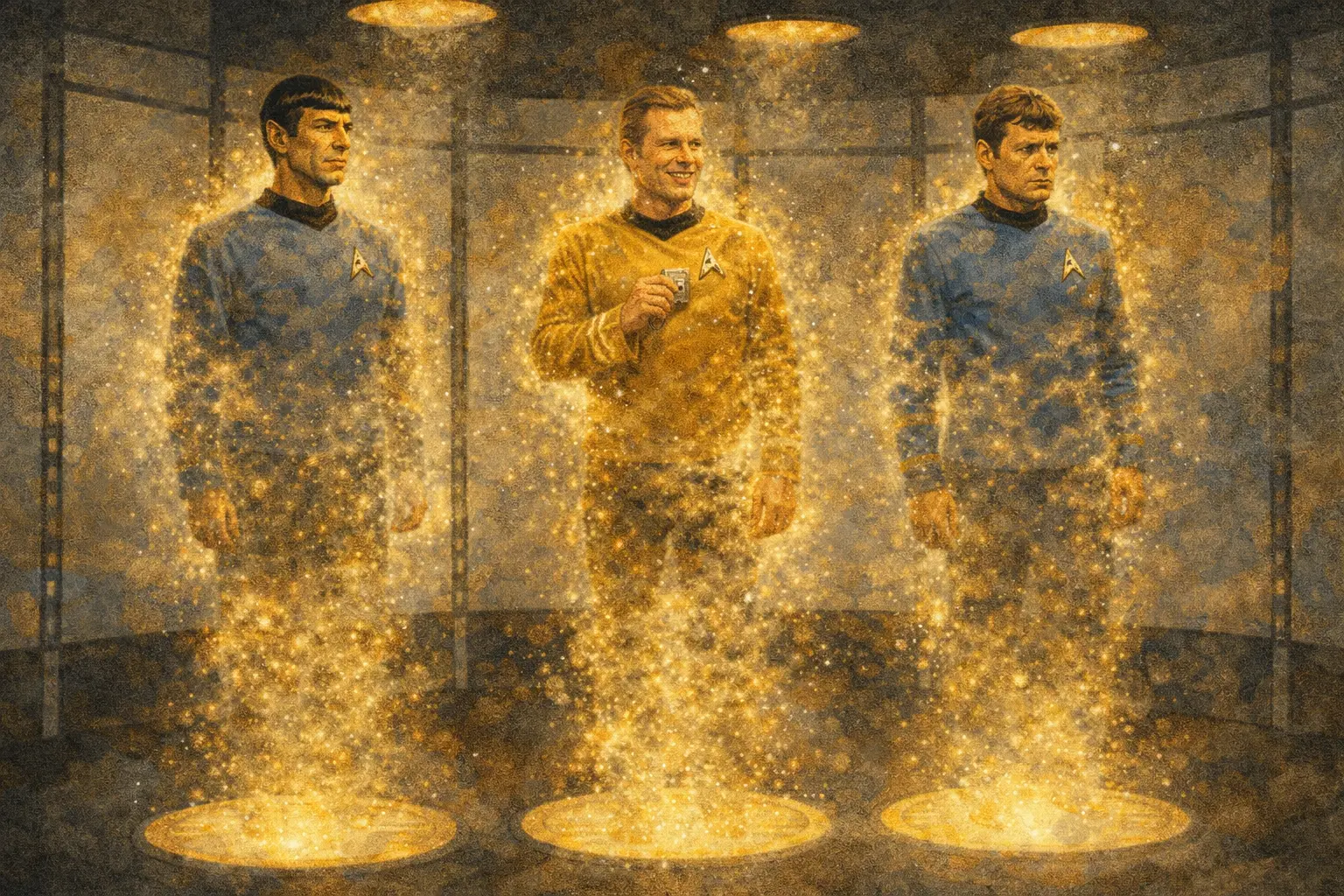
In Star Trek you walk onto a pad, someone presses a slider, and you appear on a planet. Captain Picard, of The Next Generation, gets his Earl Grey from a wall. Nobody on the bridge blinks.
I blink. If you are perfectly copied, do you survive, or are you replaced?
Dolly
In 1996 Dolly the sheep was born at the Roslin Institute in Scotland, the first mammal cloned from an adult cell. She was made from the cell of an existing sheep and had the same nuclear DNA. Nobody thought Dolly was that sheep. She had her own memories, her own habits and her own place in the field. Same genes, new sheep. Fair enough.
A transporter is something else. It doesn't copy a genome. It carries the physical and neurological state of a person, all the way down to whatever makes them feel like you. So a Dolly-style shrug doesn't work anymore.
The machine
The transporter scans you, turns you into a stream of matter, takes the original apart and builds the pattern somewhere else. Nothing looks wrong from the outside, and nothing feels wrong from the inside.
If you think you are your body, continuously, then the machine kills you. Painlessly, with no gap and no warning, and the person who steps off the pad honestly believes they are you. That last part is what I can't wave away. Nobody ever notices, including the one who died.
The British philosopher Derek Parfit described this exact machine, the teletransporter, in his 1984 book Reasons and Persons. Most arguments about it still start there.
Physics would object, by the way. The no-cloning theorem (1982) says an unknown quantum state can't be copied exactly. So a perfect copy of a person is doubtful. But the thought experiment doesn't need a working machine, so I'll go along with the show.
When it splits
Star Trek breaks its own illusion once in a while. In "The Enemy Within", an episode of the original series from 1966, a transporter accident splits Captain Kirk in two. One half is gentle, one is violent. Neither does well alone.
In "Second Chances", from The Next Generation, a malfunction left a second William Riker, the Enterprise's first officer, on a planet for eight years. Nobody knew. When he's found, both Rikers share every memory up to the split and have lived different lives since. The second one goes by Thomas. The show treats them as two people with one past, and that seems the honest reading to me.
Star Trek: Lower Decks, the animated comedy, does a version with Brad Boimler, its eager junior officer. His duplicate is believed dead and turns out to be alive. The show shrugs at it, which I find more unsettling than the whole Riker story.
So in Star Trek a person can be in two places. Physics usually says no.
Two of you
Say two copies wake up. Both remember being you. Both feel like the same person who went to sleep, and both expect your tomorrow. Afterwards each copy feels whole. Anyone watching sees two people where there was one.
I would call that survival, though it means giving up the idea that a self has to be unique, and I'm not sure I can do that. I have one body, one phone and one set of keys. Having two of me sounds like a logistics problem.
The sickbay
Every fan asks it sooner or later. If a transporter can rebuild you atom by atom, it could remove a tumour, filter out a pathogen or bring back an earlier, healthier you. That makes it odd that Star Trek still needs a sickbay.
The show does use it that way once. In "Unnatural Selection", Dr Katherine Pulaski, the ship's doctor in the second season, ages rapidly and is rebuilt from a DNA template taken from a hair sample. It stays a one-off.
A few things explain why. Pattern buffers are meant to be temporary. In "Relics" Scotty, the chief engineer of the original series, survives 75 years in one, and everybody calls it luck and a trick he rigged himself. Nobody calls it medicine. And a brain is always changing. Edit one detail and you may change another, and editing a neural pattern means editing who someone is.
Canon shows what happens when a transporter goes wrong. In Star Trek: Voyager the Vulcan security officer Tuvok and Neelix, the ship's cook, end up as one man, and in The Next Generation Riker is duplicated. Those are accidents, not edits. But a machine that can do it by accident could do it on purpose, and I suspect the writers know that.
Tuvix
Tuvix is that man, made of Tuvok, Neelix and an orchid. To himself he is simply Tuvix. He has memories, opinions and a fear of dying. Captain Janeway has him separated so that Tuvok and Neelix can come back, and the past returns by taking the life of the present.
I don't have a clean answer here, and neither does the show.
The boring reason
There is also a plain storytelling reason. If pattern editing were routine, death could be reversed and failure would cost nothing. The show would stop being about people and turn into system administration. Nobody tunes in for that.
So the writers let the transporter be a miracle when a story needs one, and a nuisance when it needs trouble. The inconsistencies keep things moving. I read the transporter as a metaphor and leave the engineering to them.
So, am I still me?
I don't think a copy would end the self. It does complicate the counting, and I don't have a tidy answer for that.
My own guess is that I'm a continuity of experience more than a set of atoms. In theory that continuity could branch. Then there would be two of me, and one of us would have to do the dishes.
— TimoDec 10, 2025