
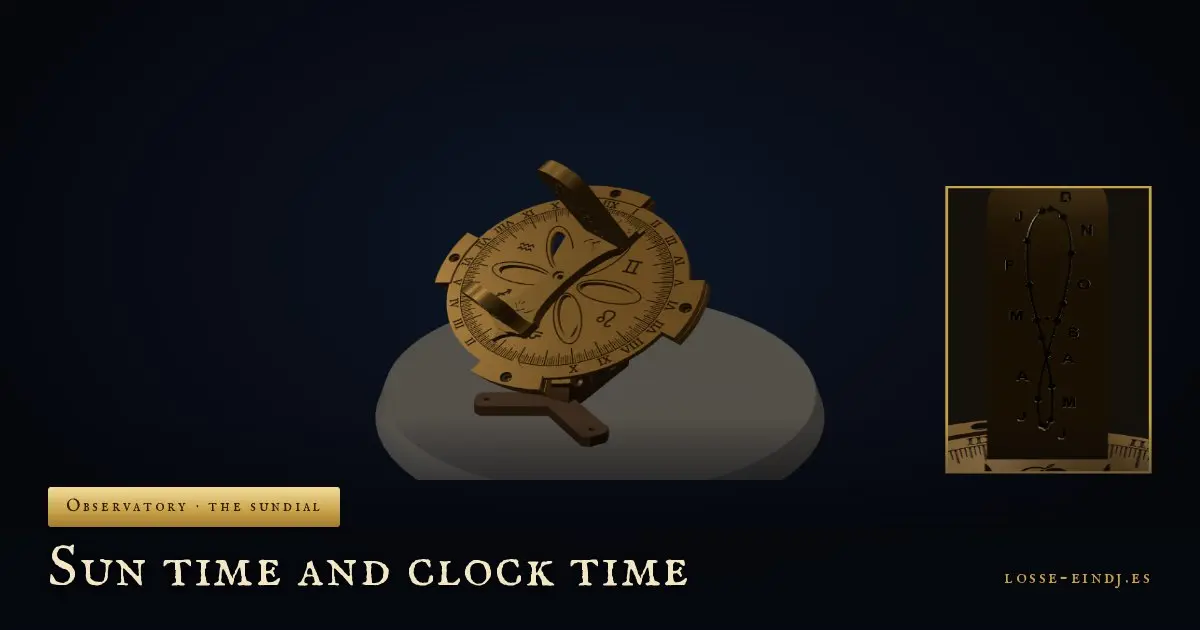
In High Noon, Gary Cooper spends the whole film watching the clocks crawl towards twelve, because the noon train is bringing trouble into town. Had the film been set in Eindhoven, he could have had a long lunch first. By the Sun, noon here comes at about twenty to one.
Ask anyone when the Sun is at its highest and they will say twelve o'clock. The Sun never agreed to that.
A sundial runs on sun time: noon is the moment the Sun stands due south. That is a perfectly good way to tell the time, except that the moment wanders over the year, and not evenly. In Eindhoven it also happens a long way after twelve.
I noticed it the way most people do, without noticing: summer evenings here stay light until well past ten, and even in winter the Sun is highest well after lunch. Our days are shifted. It took building a sundial room for the Observatory on this site before I sat down and worked out by how much, and why.
Why the Sun is a bad clock
The gap between sun time and clock time has a name: the equation of time. Over the year it runs from the Sun about 14 minutes behind the clock in mid February to about 16 minutes ahead in early November.
Two things cause it, and neither is a mistake. The Sun simply keeps a schedule that does not suit a clock.
The first is the orbit. The Earth goes round the Sun on an ellipse, and Kepler found that a planet goes fastest when it is nearest the Sun. We are nearest in early January. Then the Earth has to turn a little further each day to bring the Sun back to the south, and the Sun falls behind.
The second is the tilt. The Sun moves evenly along its yearly path, but that path is tilted against the equator, and only the part of its motion along the equator counts for the clock. That part is smaller near the equinoxes and larger near the solstices.
Add the two and you get the curve. Put the minutes across and the Sun's height up, day by day, and the curve folds into a figure eight.
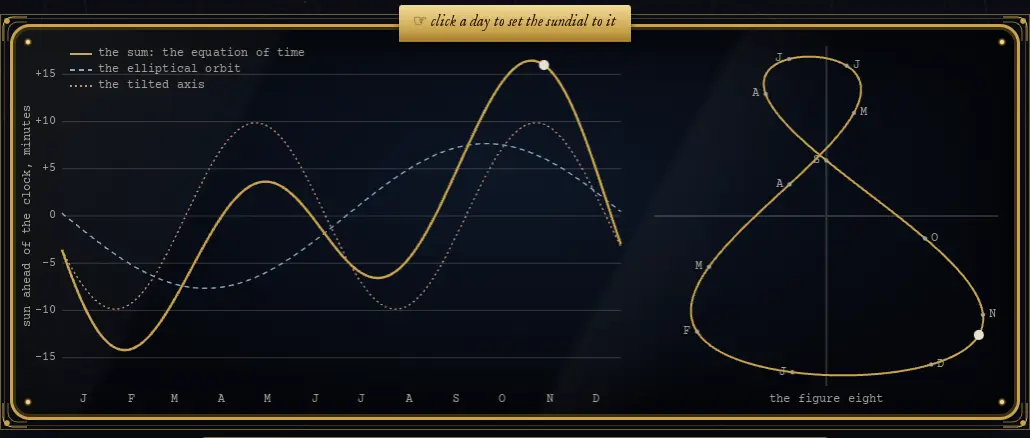
Photograph the Sun at the same clock time every few days for a year and it draws that same eight in the sky. It is called the analemma.
Why our noon is so late
Our clocks run on Central European Time, the time of the meridian 15 degrees east, through eastern Germany. Eindhoven lies 9.5 degrees west of that line. The Sun covers 15 degrees an hour, so it reaches us 38 minutes after it reaches that meridian. In summer time, add an hour.
So in winter the Sun is due south here at about 12:38, give or take the equation of time: earliest in early November, at about 12:22, latest in February, at about 12:52. In summer time it is 13:38, give or take.
Nobody in Eindhoven chose that. It came out of a string of decisions, the occupier's in 1940 among them.
Until the railways, every town kept its own sun time. From 1 May 1909 the whole of the Netherlands, railways included, ran by law on the mean sun time of the Westertoren in Amsterdam, 19 minutes and 32.13 seconds ahead of Greenwich. In 1937 that was rounded to twenty minutes. Then, on 16 May 1940, the German occupier put the country on German summer time and moved the clocks forward by 1 hour and 40 minutes in one go. The Netherlands has kept Central European Time ever since.
That is why our noon comes so late. The clocks were moved, and the Sun was not consulted. Gary Cooper would have been standing in the main street for thirty-eight minutes.
The instrument that knows all this
Every sundial on a church wall shows sun time. To turn that into clock time you needed a table, and that table was the equation of time, printed in almanacs once pendulum clocks became good enough to notice the difference.
A heliochronometer does the sum for you. It is a sundial built to show clock time, to the minute.
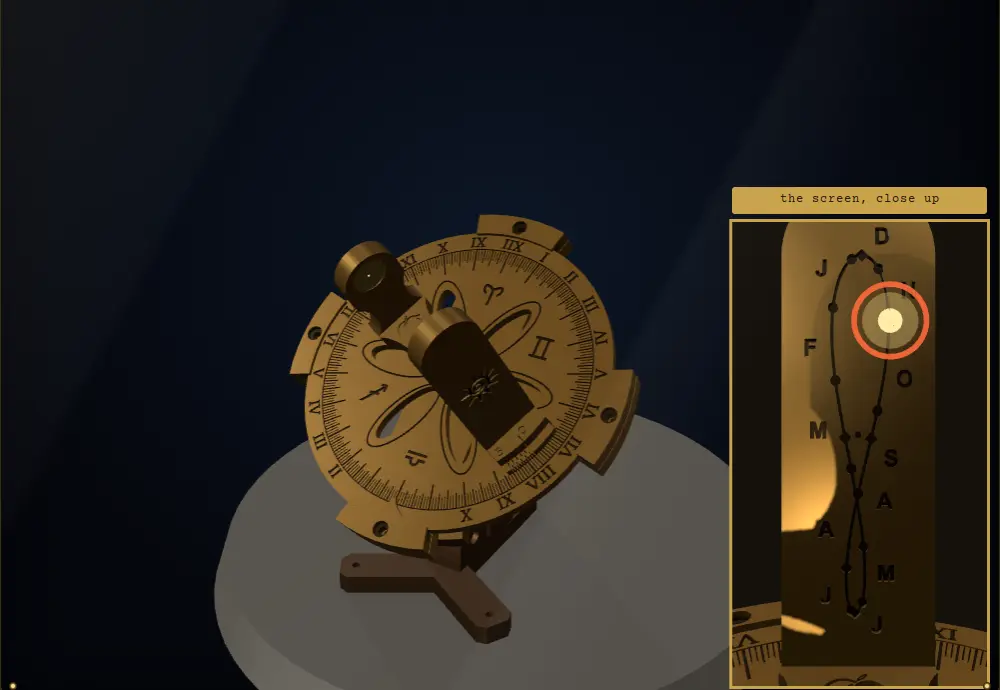
The one in the room is a 3D model, standing in Eindhoven under the real Sun of the moment you open the page. Its axis points at the north celestial pole and is tilted 51.4 degrees, Eindhoven's latitude, so the dial lies parallel to the equator and the Sun goes round it evenly, 15 degrees an hour. An arm turns over the dial. At one end is a ring with a small hole, at the other a screen with a figure eight and the twelve months.
Turn the arm to the clock time and the spot of light through the hole lands on the figure eight, at today's date: high on the screen in winter, when the Sun is low, low in summer. The instrument shows the time, and it shows when you have it wrong: if the spot misses the eight, the arm is not at the right time.
I set the arm to follow the clock by default, so the spot just sits on the eight and behaves. The more fun way is the other switch, turn it yourself: hunt for the eight with the arm and read the time off the dial. You need no watch for this, only the Sun and some patience.
Try it
The sundial room runs live: today's date, the Sun where it stands now over Eindhoven, and a year of early and late below it. Slide the day to February and watch the spot crawl along the eight. Then compare it with your watch.
The instrument is "Heliochronometer – World's most accurate sundial" by 3DMason on Printables, licensed CC BY-NC-SA 4.0; on the page its parts are separated so the arm can turn, and shared under the same licence.
Part of the Observatory, a museum of live instruments on this site. Walk in: the floor plan →
— TimoNov 13, 2026