
A table is solid. You can put your coffee on it, bang your knee on it, and it stays a table. Everything we know from daily life says the world is made of things, and the things sit in empty space.
For a few centuries science agreed. Newton gave us the laws of motion and gravity, and the universe started to look like a very large clock. In 1814 the French mathematician Pierre-Simon Laplace took it one step further: know where everything is and how fast it moves, and you could in principle calculate the whole future. Engineers still work with Newton every day. Bridges stay up. So it can't be all wrong.
But the closer physicists looked, the less solid the world became. The best picture I know for that comes from 1999, from a film with a lot of leather coats in it: The Matrix, by the Wachowskis. I saw it the year it came out. On an illegal DVD copy. Sorry, Warner Bros.
The clock starts to wobble
In Newton's world a thrown ball follows a neat curve, planets go round in ellipses, and time runs the same for everybody. Then Einstein came along and made gravity a matter of geometry. Mass bends spacetime, and things simply follow the bends. Space stopped being the stage and joined the play.
Around 1900 the small stuff started acting up too. The German physicist Max Planck found that hot objects give off energy in fixed little packets. In 1905 Einstein used the same idea for light itself, which got him his Nobel Prize. Particles turned out to behave like waves, as the French physicist Louis de Broglie proposed in 1924. Measuring something changed it. Three of the founders of quantum mechanics, the Dane Niels Bohr and the Germans Werner Heisenberg and Max Born, concluded that at that scale you get probabilities, not certainties. Einstein never accepted that part. "God does not play dice" is from a letter he wrote to his friend Born in 1926. Born kept playing anyway.
Ripples in fields
From the 1920s to the 1940s physicists built quantum field theory: Paul Dirac first, later Richard Feynman, Julian Schwinger and Sin-Itiro Tomonaga, who shared the 1965 Nobel Prize for their part. In that picture the universe is filled with fields: one for electromagnetism, one for electrons, a few for quarks. Even empty space has them, always stirring a little.
A particle is what you get when a field vibrates in a stable way. A photon is a ripple in the electromagnetic field. An electron is a ripple in the electron field. Think of a flag in the wind. The wave runs along the cloth without taking the cloth anywhere, and you can still follow it with your eyes.
Our senses were built for apples and predators, so this is hard to picture. I needed help.
The green screensaver
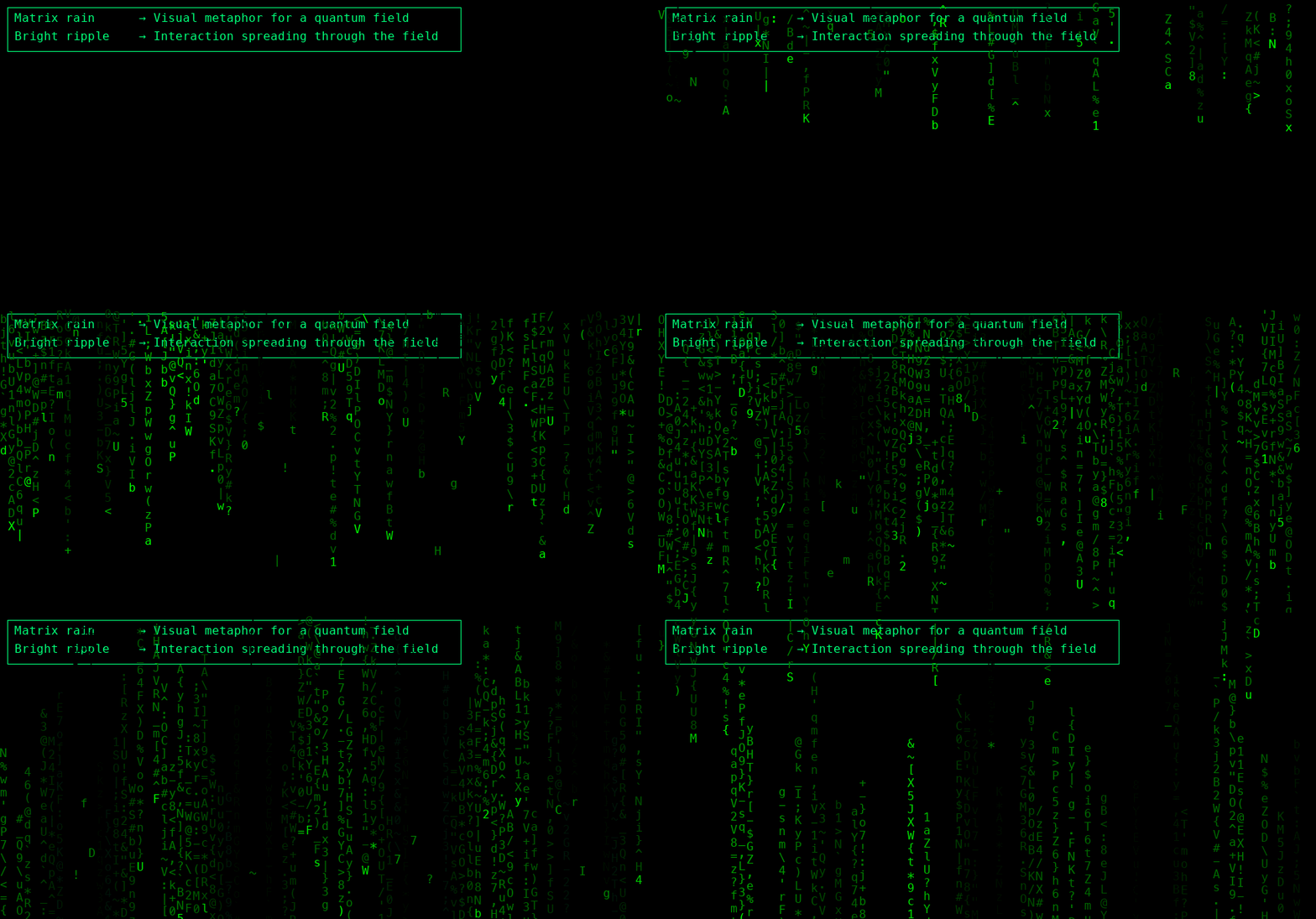
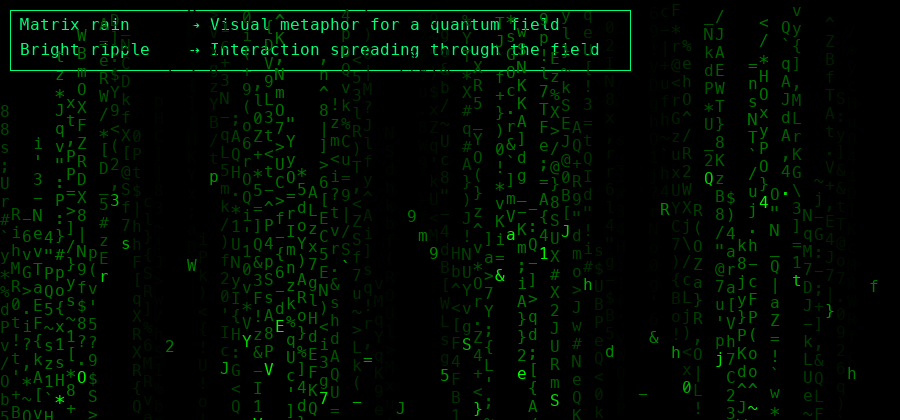
In The Matrix the world is a simulation, and Neo, the hacker played by Keanu Reeves, has to learn to see through it. The green characters raining down the screen are what it looks like underneath. I use the image the other way round from the film: the green rain is the fields, and the chairs and planets are what we see on top. A particle is a recognisable ripple in the rain. An object is a lot of ripples that hold their shape. And motion is the pattern changing.
The Higgs, a setting in the background
In 1964 three groups independently proposed it: the British physicist Peter Higgs, François Englert and Robert Brout in Brussels, and Gerald Guralnik, Carl Hagen and Tom Kibble in London. They proposed a field that fills all of space. Particles that couple strongly to it are heavy, particles that couple weakly are light, and the photon ignores it and has no mass at all. On 4 July 2012 CERN, the European particle physics laboratory near Geneva, announced that its two big detectors, ATLAS and CMS, had found the particle that goes with it, at about 125 GeV. Higgs and Englert got the Nobel Prize the year after.
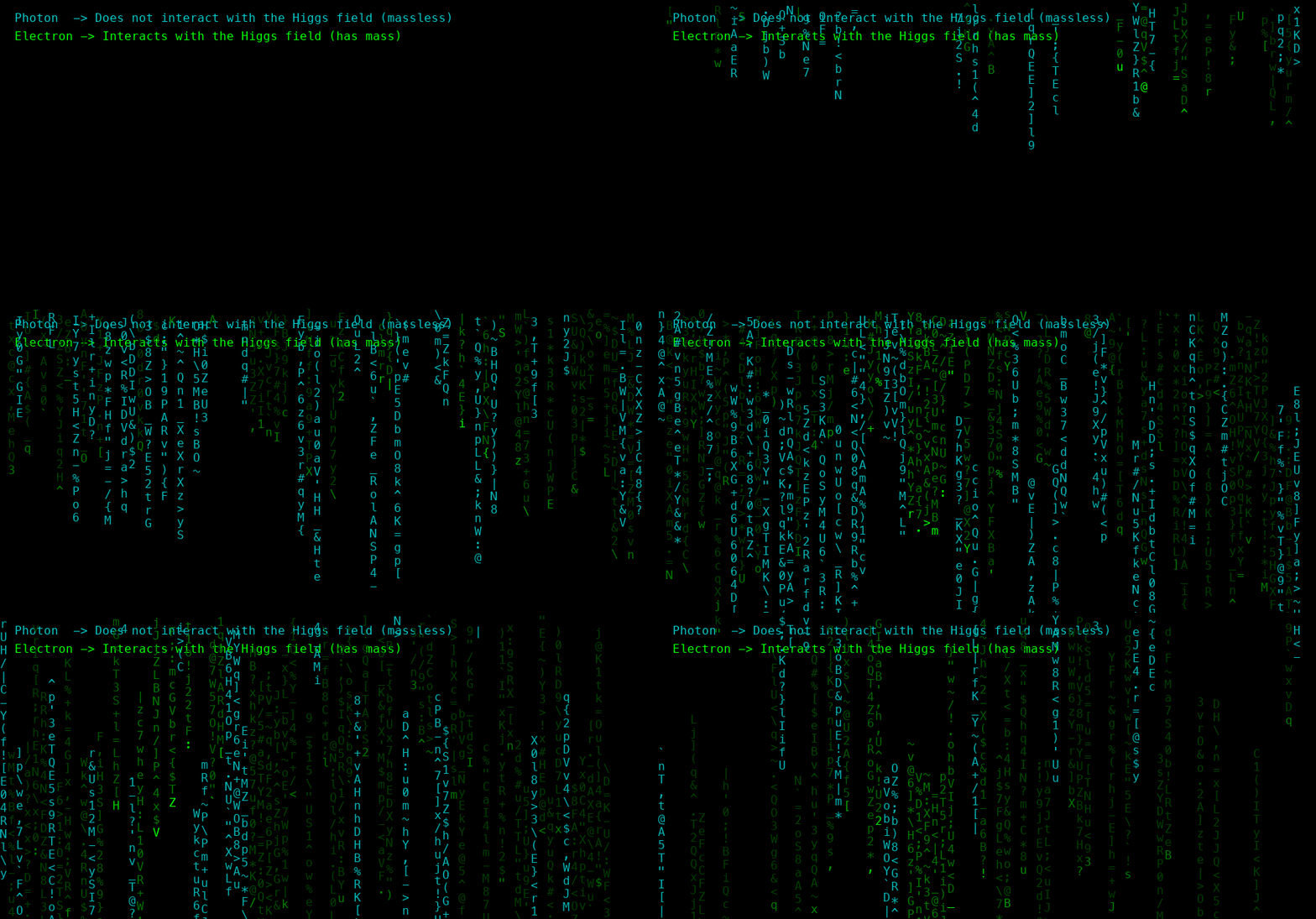
The usual picture is particles wading through syrup. Physicists don't like it much, because nothing is being slowed down. The field sets how strongly each particle couples to it, and that is its mass. In my screensaver version it's a hidden setting in the code.
One thing the Higgs is not: the source of all mass. It gives the fundamental particles their mass, but the quarks in a proton weigh about one percent of the proton. The rest is the energy of the strong force holding them together. So most of what the bathroom scale tells you in the morning comes from binding energy, not from the Higgs. CERN explains it well. I find that oddly comforting.
Black holes as paper shredders
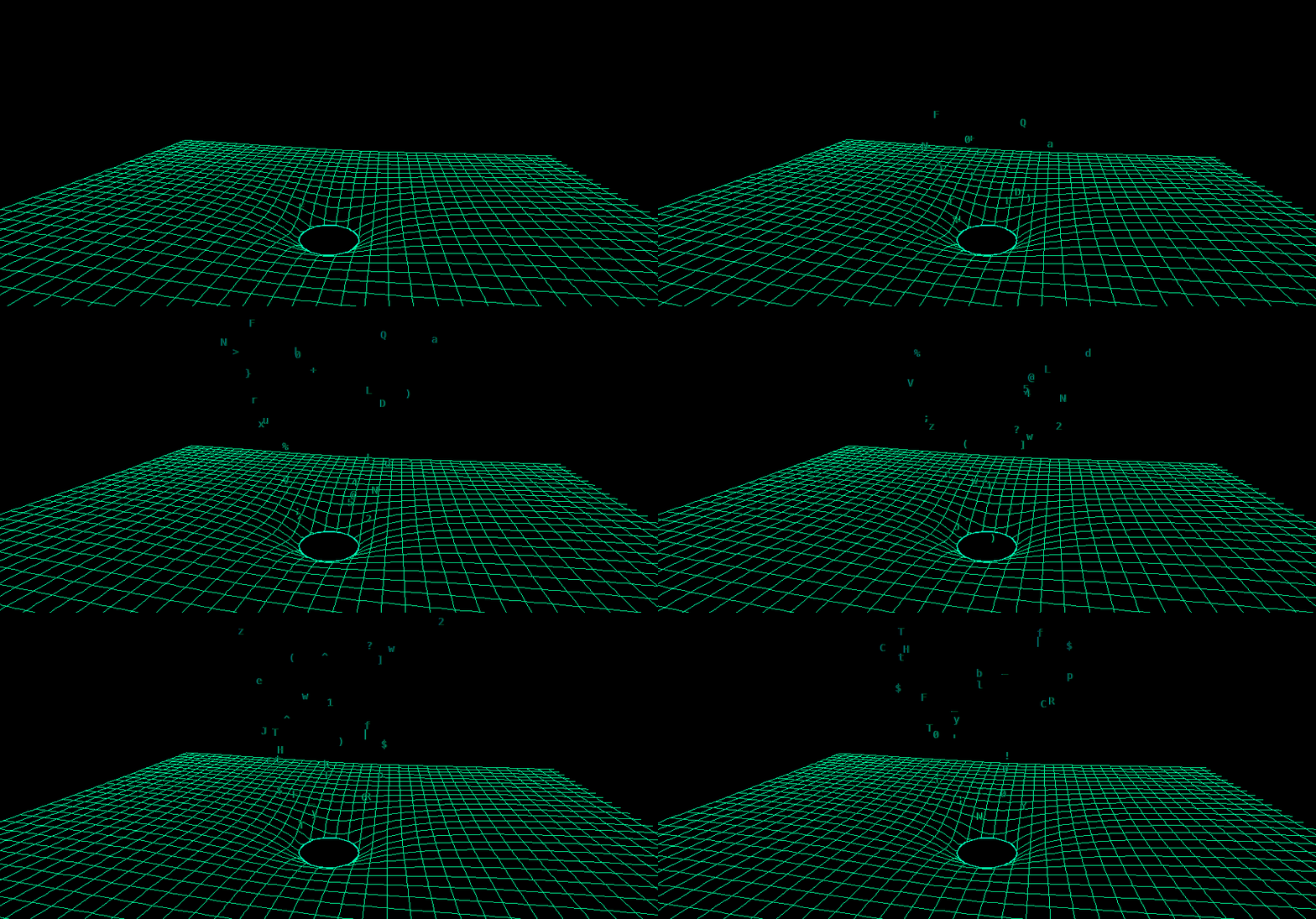
In 1974 Stephen Hawking showed that black holes give off radiation and slowly evaporate. That raised a nasty question. Quantum theory says information can never be destroyed. So where does everything that fell in go?
Most theorists now think it comes back out in the radiation, scrambled beyond recognition. Like a letter through a shredder: all the pieces are still there, good luck putting it back together. In Matrix terms, a clear message turned into a dense stream of symbols. It isn't settled. So far it's calculations on paper; nobody has measured it.
We already touch the code
Your radio picks up waves in the electromagnetic field. A laser makes light of one exact colour. An MRI scanner tips the spins of the protons in your body and listens to what comes back. Particle accelerators shake the fields hard enough to make new particles appear for a fraction of a second.
That's engineering. None of it needed a rule to be broken.
And spacetime itself?
Some theories go further and suggest that spacetime itself comes out of something deeper, maybe the way quantum information is entangled. Then the screen in my screensaver would be made of the green rain as well. This is where physicists are still trying to get quantum mechanics and gravity to agree, and they haven't managed yet.
At the end of the film Neo stops seeing walls and bullets and sees the code. I'm still bumping my knee on the table.
— TimoFeb 12, 2026