
In Dune there is one spice, it grows in one place, and whoever controls it controls the universe. Great houses scheme over it, a trading company keeps the books, fleets are sent to the one world where it grows. Science fiction.
I knew that universe first as a game. Dune 2000, from 1998: harvesters crawling over orange spice fields, sandworms swallowing them whole. Then the old TV miniseries. Only after that did I read the book.
Swap the desert for green volcanic islands and the spice for a small brown nail, and you have the history of Maluku. Only here the trading company was real, and it was Dutch.
There is a small brown nail-shaped spice in most kitchen drawers in the Netherlands. Few people who sprinkle it on red cabbage know that for the better part of two centuries, wars were fought over it in the islands my family comes from.
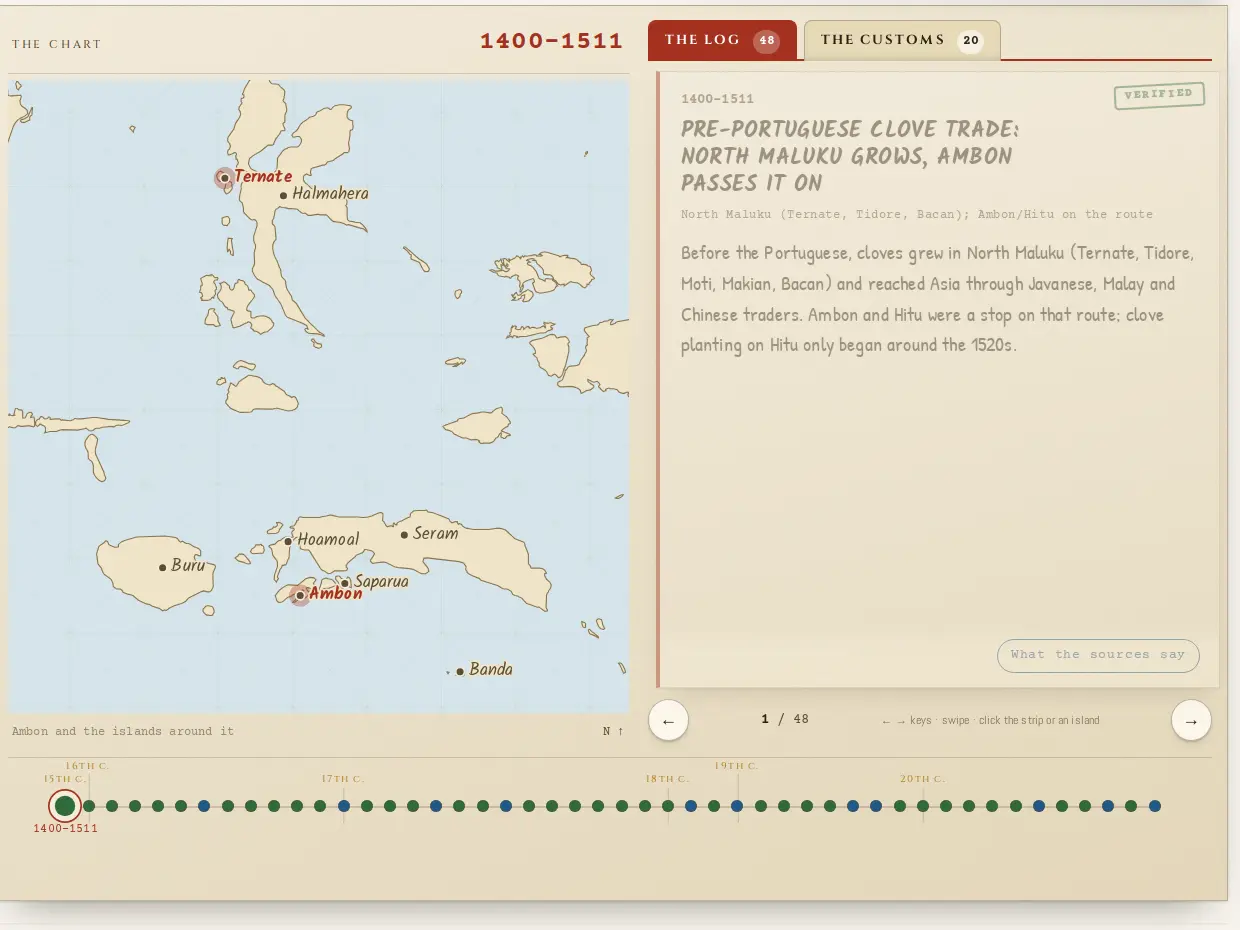
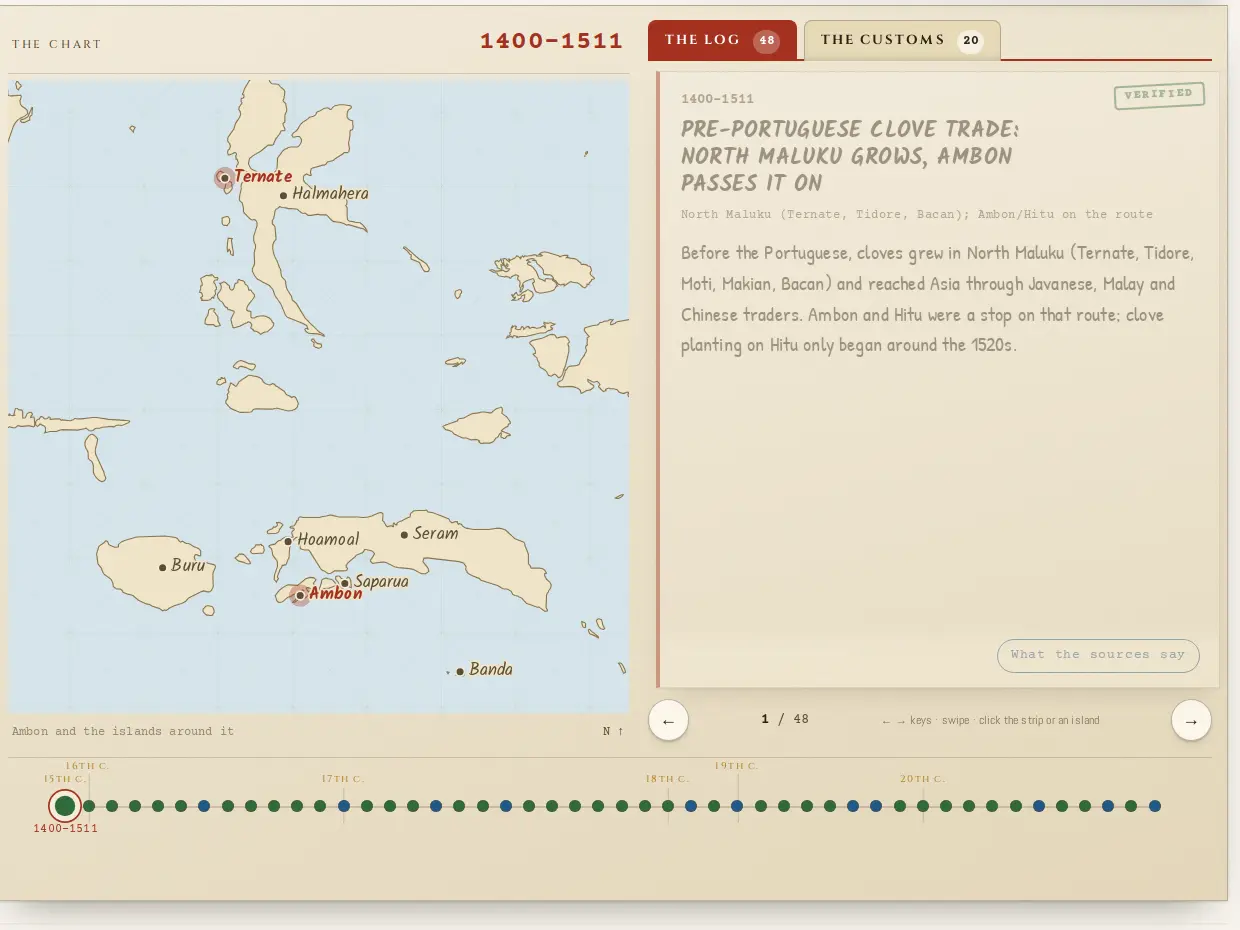
The timeline on this site, Maluku, five centuries, has forty-eight entries in its log, each with a verification stamp and the sources it was checked against. I did not try to retell all forty-eight. I followed one thread through them: the clove. It runs through most of the entries, and it explains why so many of the others happened where they did. Every entry I use here is stamped verified, unless I say otherwise.
Before the ships
Cloves grew in North Maluku, on Ternate, Tidore, Moti, Makian and Bacan. Traders from Java, from the Malay world and from China came to buy them and carried them across Asia. Ambon, and the north coast of Ambon called Hitu, were a stop on that route, not the source. Hitu only began planting cloves itself around the 1520s.
The Portuguese arrive, 1512
The Portuguese had taken Melaka in 1511, and that November an expedition sailed from there for the Spice Islands. Early in 1512 it reached Banda. Francisco Serrão's ship was wrecked, and he came ashore on Hitu. The same year a war fleet from Ternate fetched him, because the sultan of Ternate wanted the newcomers as allies. The log calls it the start of a century of alliances and rivalries over cloves.
The Portuguese did not turn Ambon into a clove market. From 1518 their ships used Hitu to wait out the monsoon between Ternate and Melaka, and they were allowed to build a wooden trading house east of Hitulama. It was a way-station more than a trading centre, and cloves were only just beginning to be planted there. Hitu drove them out in 1537.
The Dutch, 1599 to 1605
Dutch ships reached Ambon in February 1599 and stayed at Hitu until May. A year later Hitu made a pact with them: military help in exchange for cloves. The Dutch built a small fort near Hila, the Kasteel van Verre, but a Portuguese expedition soon drove them off the island. Hitu's envoys then went looking for Steven van der Hagen in Bantam.
In March 1602 the States General had merged six Dutch trading companies into one, the VOC, and given it a monopoly on trade with Asia, with the right to make treaties, build forts and wage war. In February 1605 Van der Hagen sailed into Ambon Bay with a VOC fleet. The Portuguese governor, Gaspar de Melo, surrendered the fort without a fight, and the Dutch renamed it Victoria. The log gives only the month, because the sources give 22 and 23 February.
Cloves by contract, 1620s
The clove trade became a matter of contracts. From the 1620s the VOC bound the rulers and villages of the Ambon islands to sell their cloves to the Company alone. Selling to anyone else was smuggling. Governor Herman van Speult's agreements after 1625 turned many people against the Company, according to Mostert.
Nutmeg had been settled by force earlier. In 1621 the VOC under Jan Pieterszoon Coen conquered the Banda Islands. Of some 15,000 Bandanese, about a thousand were left on the islands afterwards. The sources differ on how the rest were killed, enslaved, deported or made to flee, but historians count the conquest among the worst colonial atrocities of the region. Banda is a day's sail from Ambon.
In 1625 the Nassau fleet arrived, and Van Speult led a kora-kora fleet around Hoamoal, on the west coast of Seram, and the islands nearby. It destroyed villages, boats and, above all, clove trees. Mostert calls it the VOC's first clear act of economic and environmental warfare in the islands.
Hitu says no, 1633 to 1646
Hitu did not accept the contracts quietly. The Company approved Kakiali as Kapitan Hitu in 1633. Within a few years he was leading the island against the clove monopoly, with Makassarese and Butonese allies, from the mountain fort of Wawani. The Company could not beat him in the field. On the night of 16 August 1643 a Spanish deserter, sent by governor Demmer, stabbed him to death in his sleeping quarters. Five days later Wawani was stormed. The people of Hitu were made to move down from the hills to the coast, and the four perdanas, Hitu's old rulers, were abolished.
Telukabessy held out at Kapahaha, above Morela, for three more years. The fort fell on 25 July 1646.
Trees cut, and a treaty, 1651 to 1656
In early 1651 surprise attacks struck the VOC posts on Hoamoal, and five years of war followed. When it ended in 1656, the Company declared Hoamoal and the islands nearby an "eternal wasteland" and deported the few people left. Mostert says the peninsula was already all but empty by then.
In January 1652, in Batavia, Sultan Mandarsyah of Ternate signed a treaty. It allowed the Company to destroy the cloves of everyone who had risen against him, in North Maluku and around Ambon, and it forbade them ever to plant again. If it worked, his yearly payment would rise to 12,000 rials. By 1655 cloves had been rooted out of North Maluku, the islands where they first grew.
The date needs a note. Mostert cites the treaty as signed on 31 January 1652. The MOZA timeline and Wikipedia give 31 July 1652. The log follows Mostert, and so does this post.
The hongi fleets, to 1824
After the war the VOC kept the monopoly with yearly hongi voyages. Fleets of kora-kora, the large outrigger rowing ships used in Maluku for war and for ceremony, toured the islands. They inspected the groves and cut down every clove tree the Company had not allowed, so that supply, and the price, stayed in its hands. The voyages lasted until their abolition in 1824.
1824, and what came after
This is the least settled part of the thread. The entry itself is verified, but one question in it is still open. In 1824 Governor-General Van der Capellen toured the Moluccas, condemned the abuses of the Company era and abolished the spice monopoly and the limit on spice trees. A year later, under pressure from the Netherlands, the monopoly was restored, now defended as protection for the "poor Moluccan". The forced clove cultivation ended on 1 January 1864, according to an army officer writing in 1897 and the MOZA timeline. P.G. Post's account of the period says the core of the system survived those four decades.
Where the thread leads
For a Moluccan family in the Netherlands, these are not abstract place names. Hitu, Hoamoal, Saparua, Seram: they are names you grow up with, usually without the history attached. Putting the history back, entry by entry and source by source, is why the timeline exists.
The spice must flow, they say on Arrakis. In Maluku, for two centuries, a company decided where it flowed, and whose trees were cut so that it would not flow anywhere else.
Next time there is a clove in the red cabbage, that is the story it carries. The log has the rest.
Sources
- Tristan Mostert, Spice War: Ternate, Makassar, the Dutch East India Company and the struggle for the Ambon Islands (c. 1600–1656), Leiden, 2023.
- R.Z. Leirissa, St. Francis Xavier and the Jesuits in Ambon (1546–1580).
- John Villiers, "Trade and Society in the Banda Islands in the Sixteenth Century" (1981).
- P.G. Post, Constructing colonial legitimacy in the Moluccas, 1750–1870 (2025).
- Ambon. Met vier illustratiën (1897), by an officer of the Netherlands-Indies army.
- MOZA, Tijdlijn (Sejarah Maluku).
— TimoNov 25, 2026