
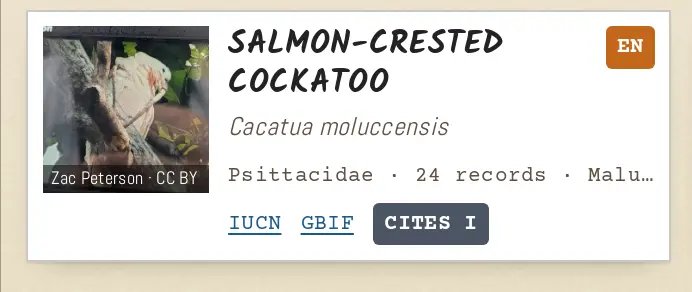
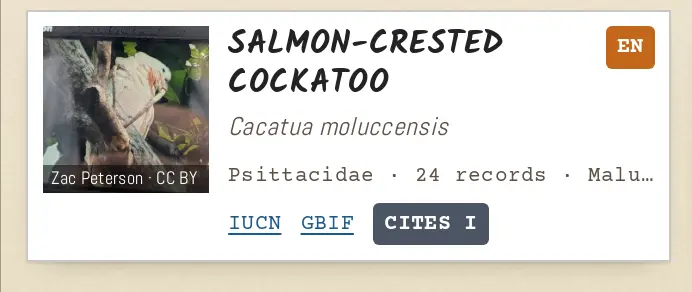
Of all the cards on Endangered in Maluku, there is one most people would recognise without reading it. A big pale bird with a salmon-pink crest it can fold flat or raise like a fan. The Moluccan cockatoo, Cacatua moluccensis. In English it is the salmon-crested cockatoo; in Dutch simply the Molukse kaketoe.
On the page its card says: endangered, 24 records, Maluku and Maluku Utara, CITES I. Four short facts. Behind each one is a story about how a bird from a handful of islands ended up nearly everywhere except at home.
A very small home
The cockatoo is endemic to the South Moluccas: Seram, Ambon, Saparua and Haruku, and nowhere else in the wild. That is the whole natural range, and one of those islands is personal. My family comes from Ambon, and I still have family there.
It is also a range that is shrinking from the edges. According to BirdLife International, which assesses the species for the IUCN Red List, there are no recent records from Saparua and Haruku at all. On Ambon, local reports say it was common until around 1970. That is within living memory. The most recent survey on the island found about one per square kilometre.
That leaves almost the entire population on one island, Seram, across the water.
So when the card on our page also lists records under Maluku Utara, the northern province, that is worth a second look. The species does not naturally live there. A cockatoo seen in the north has most likely travelled there in a cage.
Ten thousand a year
The main cause is simple: people wanted the bird.
In the 1980s, BirdLife concluded from export and import reports to CITES that at least 10,000 Moluccan cockatoos were taken from Seram every year. BirdLife itself calls that conservative. Today it estimates the entire wild population at 20,000 to 62,000 birds.
The forest held more cockatoos in the 1980s than it does now. Still, ten thousand a year would be between a sixth and a half of every wild Moluccan cockatoo alive today.
In 1989 the species was listed by CITES, and reported international trade practically stopped. That is the CITES I on the card: international commercial trade in wild-caught birds is banned. It worked, as far as borders go.
It did not end the trapping. Most of the trade now stays inside Indonesia, according to BirdLife, much of it going to Java, where large numbers of birds are kept as pets. The species has also turned up in large numbers in the trade in the Philippines.
Endangered, again
For years the Red List had the Moluccan cockatoo as vulnerable: in 2008, 2012, 2013 and 2016. In 2024 it was moved up to endangered.
BirdLife's numbers are not kind. It estimates the population has fallen by 50 to 79% over the past three generations. For a bird that lives this long, one generation is 21.4 years, so three generations reaches back to 1959. And it adds a line I keep rereading: even if every threat stopped tomorrow, a growing population would likely take many decades to recover.
What it needs
The cockatoo lives in lowland rainforest, up to about 1,400 metres. The highest densities were found in unlogged forest below 180 metres, the forest that is easiest to reach and easiest to cut. It nests in big old trees and its numbers go with the presence of strangler figs. It eats berries, nuts, seeds, coconuts, and insects and their larvae.
Seram has a national park, Manusela, and the cockatoo lives in it. That turns out not to be enough on its own. Inside the park, the densest population was found at a site under strict protection with active conservation work. At Sasarata, inside the same park but where anti-poaching rules are not strictly enforced, the density was a fraction of that: 1.6 birds per square kilometre. It is the same forest, in the same park. Only the enforcement differs.
Outside the park it gets harder. Satellite data show forest loss on Seram increasing since around 2014, especially in the north-east, and every cleared patch also makes it easier for trappers to get in.
What would help
There is captive breeding in several places, BirdLife notes, but no coordinated programme. What it asks for is plainer: real protection for the lowland forest of Seram, and enforcement that works.
The photo on the card is by Zac Peterson, shared under CC BY. You can find it in the bird drawer, between the other islands' names.
Sources: BirdLife International, species factsheet Cacatua moluccensis (IUCN Red List assessment 2024); GBIF records and IUCN categories as shown on Endangered in Maluku; CITES Species+.
— TimoNov 27, 2026