
In Night at the Museum, the exhibits only come to life after closing time, when the night guard is alone with them. I wanted a museum where they never stop.
The astrophysics pages on this site used to be loose. A double slit on one page, a black hole on another. Each one worked, and none of them knew the other existed.
That is how they were built: one question at a time, each answer raising the next. After a while I had a pile of instruments and no building to put them in.
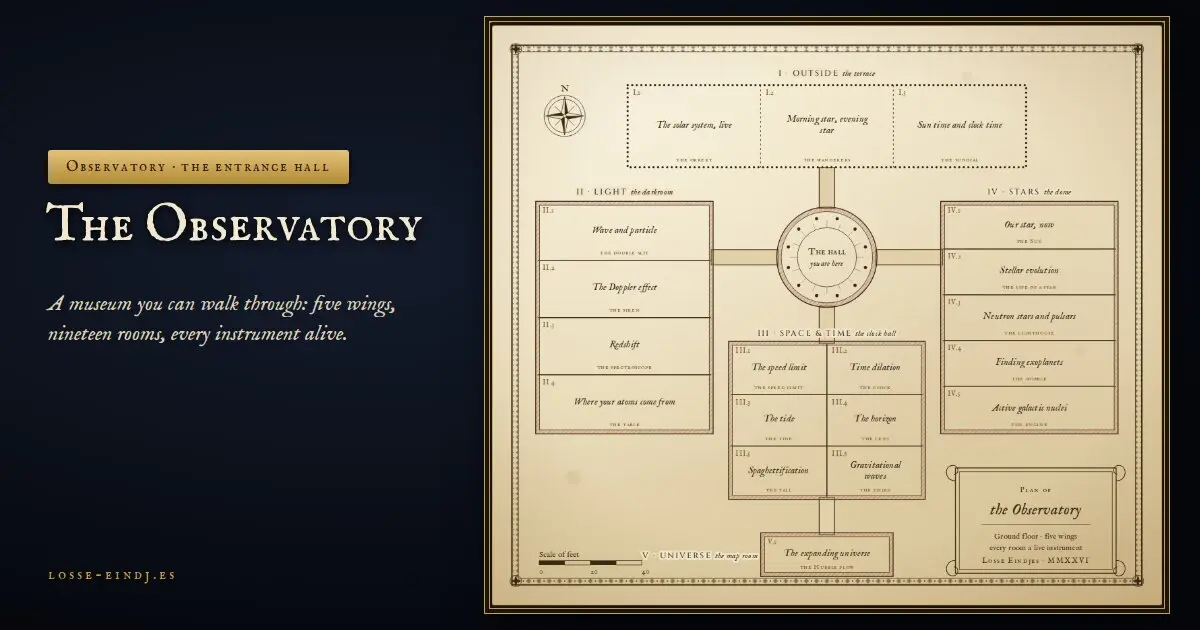
On 8 November they became one: the Observatory. Five wings back then. A week later it was six wings and 26 rooms, plus the gallery in the hall, and each room is built around one working instrument. This post is the guided tour, for the people who read the label before they press the button. I am one of them.
Got only a minute? Go to the solar system, live and see where the planets are tonight.
The plan
The front door is a plan of the building, drawn as an architect would have drawn it in the nineteenth century: sepia ink on cream paper, hatched walls, a domed hall in the middle with a ring of columns and a small you are here, the wings around it, joined by corridors. There is a compass rose, a scale of feet and a title cartouche with scrolls, because a museum plan without those looks like a sketch on a napkin.
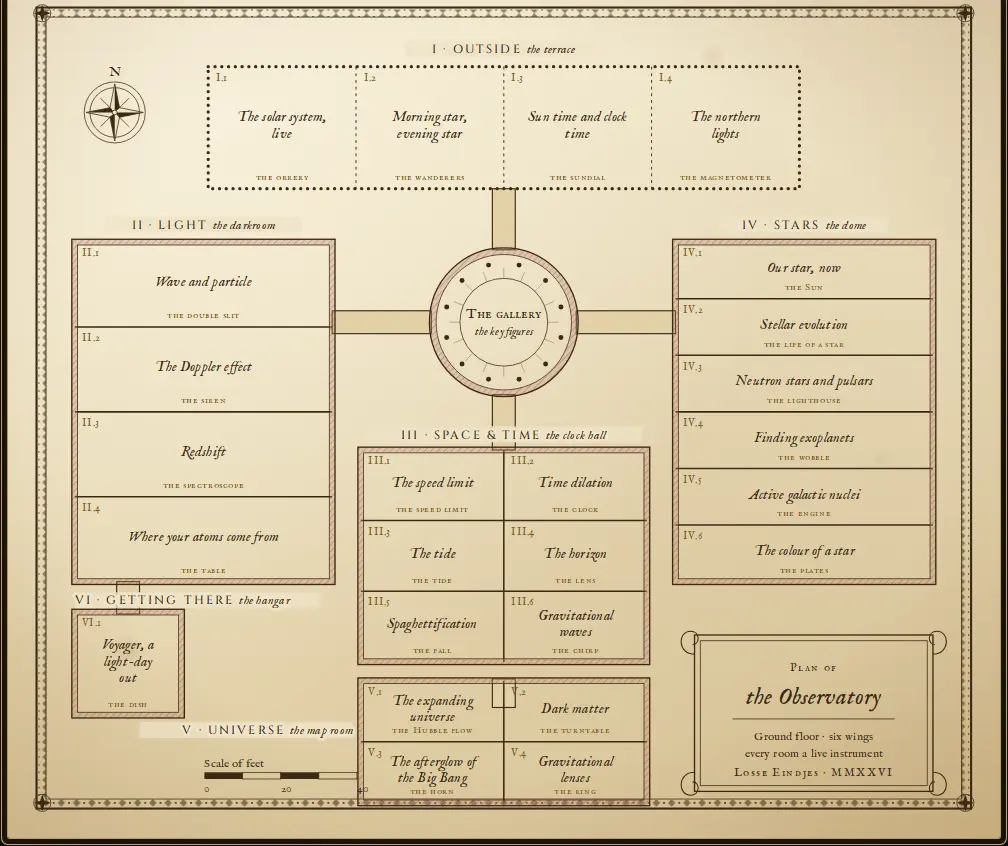
Click a room on the plan and you are in it. You can go straight to the one you want, or walk the building in order. Below the plan are five walks that cut across the wings: black holes, stretched light, where you come from, and two more, for when you want to follow a subject instead of a corridor.
The house rule
There is one rule for the whole building, and I wrote it in Dutch: het mag niet static. An instrument may never be a still picture.
No waiting for closing time, either. Nothing in the Observatory is a stock image. Every room is an instrument that works out its subject in your browser, from a single line of physics, and moves. The planets are where they are now. The Sun is today's Sun. The sundial stands under the Sun of the minute you open it.
The rule came from looking at a lot of science pages that are, in the end, a diagram with a caption. I wanted something you can push.
What a room looks like
The rooms all follow the same pattern, so once you have been in one you can find your way in the others.
At the top, a door plate: Wing II · the darkroom, Room III of IV. Then a brass name plate with an inventory number, like Inv. no. II.3 · the spectroscope. A yellow post-it carries the one line of physics the room is about. Then the instrument itself, behind glass in an engraved frame, with brass vernier sliders for whatever you can change.
Below it, a page from the observatory logbook, on lined paper, headed Where it already matters. At the very bottom, a footnote that says exactly what was calculated, with the sources.
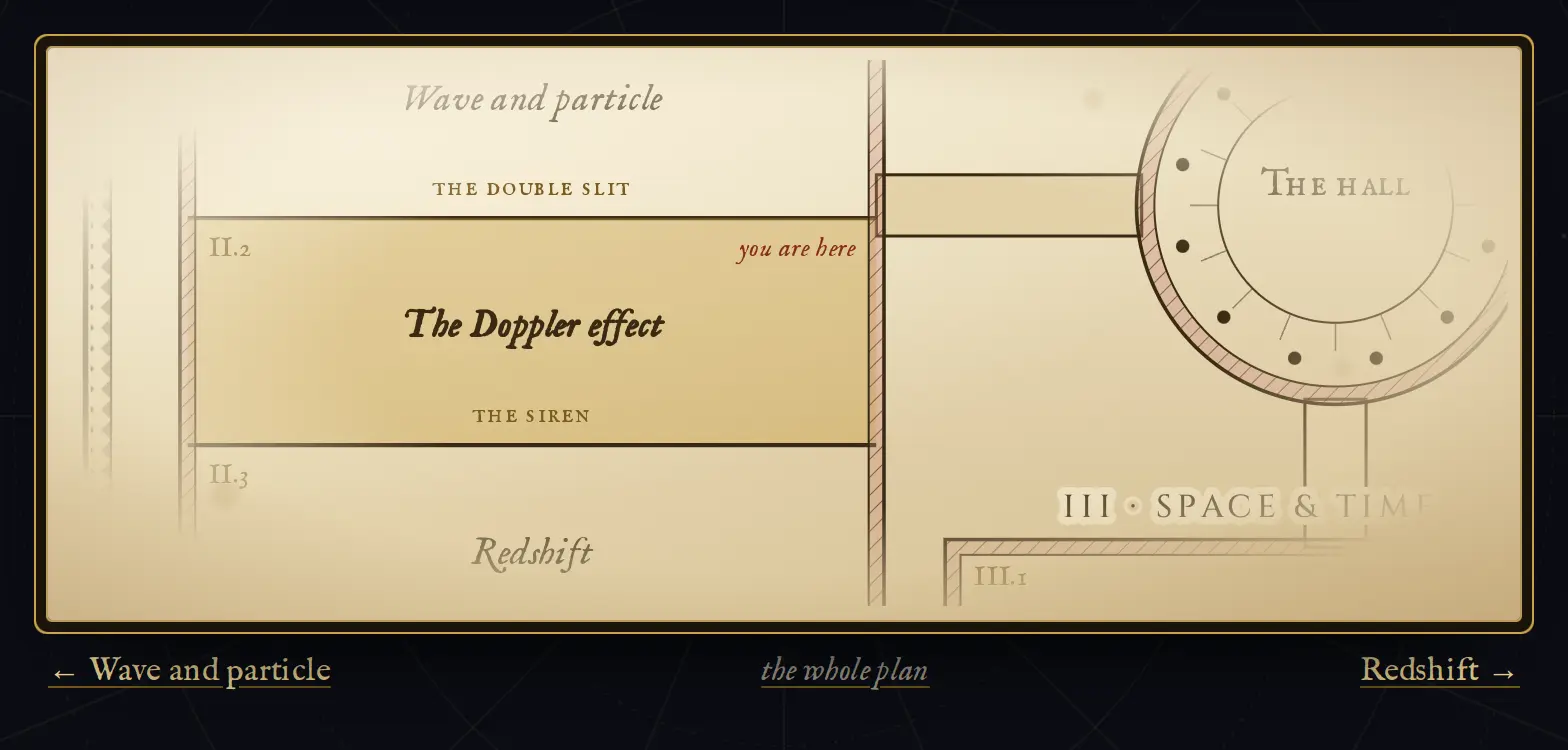
And then, at the bottom, the way on. A piece of the plan itself, cut out around the room you are standing in: your room marked you are here, the rooms either side, and at the end of a wing the hall and the corridor to the next one. Every room on it is a link. You can start on the terrace and walk out of the map room without ever going back to the big plan.
The look is a Victorian scientific museum, and I mean museum, not steampunk. No gears and pipes glued onto everything. Brass plates, engraved frames, the IM Fell typefaces, cream labels under the figures.
The wings
The terrace is outside, under the sky over Eindhoven, because that is where I live and where the skies in the building are calculated for. Start with the solar system, live: the planets as they stand today, with a time machine and an eyepiece on Jupiter's moons. Venus and Mercury never stray far from the Sun, as Morning star, evening star shows. The brass sundial on the terrace is set to the real Sun, which is why noon here is never at twelve. On a good night the northern lights tell you whether the aurora clears Eindhoven's northern horizon. Usually it doesn't.
The darkroom is about light, and how we know anything at all about things we cannot visit. Photons go through two slits one at a time in wave and particle, and still build the stripes only a wave can make. A star's barcode of dark lines gets read in redshift, where motion, gravity and expanding space are told apart.
The clock hall is about time, and about gravity bending it. In time dilation one clock sits near a black hole and one on a fast train. GPS satellites need both corrections: they move fast, and they sit higher up in the Earth's gravity than we do. The horizon ray traces a black hole photon by photon, in your browser, disk and all. Then spaghettification asks whether you are torn apart before or after the event horizon. Near a black hole of a few suns you are stretched long before you reach it. A supermassive one lets you cross in one piece, which is the wrong way round from what you would expect.
Under the dome are the stars. Today's Sun, in five kinds of light from NASA's Solar Dynamics Observatory, is in our star, now. In neutron stars and pulsars you can listen to real ones, city-sized stars spinning up to hundreds of times a second. And the colour of a star sorts the old Harvard glass plates into O B A F G K M while you watch.
The map room is the universe as a whole. Galaxies sit on a stretching grid with no centre in the expanding universe: click one and stand on it, and the picture is the same. I wrote a separate post about that one. Dark matter spins a galaxy the way it really turns, then with only the matter that shines, and the outskirts fly off. The young universe clears like fog in the afterglow of the Big Bang, and in gravitational lenses a galaxy behind another one bends into arcs and rings.
The hangar is the youngest wing. It is about getting into space. Its first room is Voyager, with both probes live. A radio call now takes a day to reach Voyager 1, and the room shows which dish, in Canberra, Madrid or Goldstone, is listening to it this minute.
The people, in the hall
Most rooms have a small cabinet card for a scientist who belongs there. Galileo, Newton and Einstein, of course, but also Henrietta Leavitt, who found the yardstick that measures the distances to galaxies, and Jocelyn Bell Burnell, who spotted the first pulsar as a PhD student. All of them meet in one place: the hall in the middle of the plan.
That hall is a room you can walk into, in 3D, right in the browser. The gallery is a rotunda under a coffered dome, with a brass solar system hanging from the glazed skylight, each planet where it is today and the Moon going round the Earth. Ten scientists stand in bronze in a ring around it, facing the middle; the others hang between the columns as painted portraits or brass medallions. Four doors lead out of the hall, north, east, south and west, the way the corridors run on the plan.
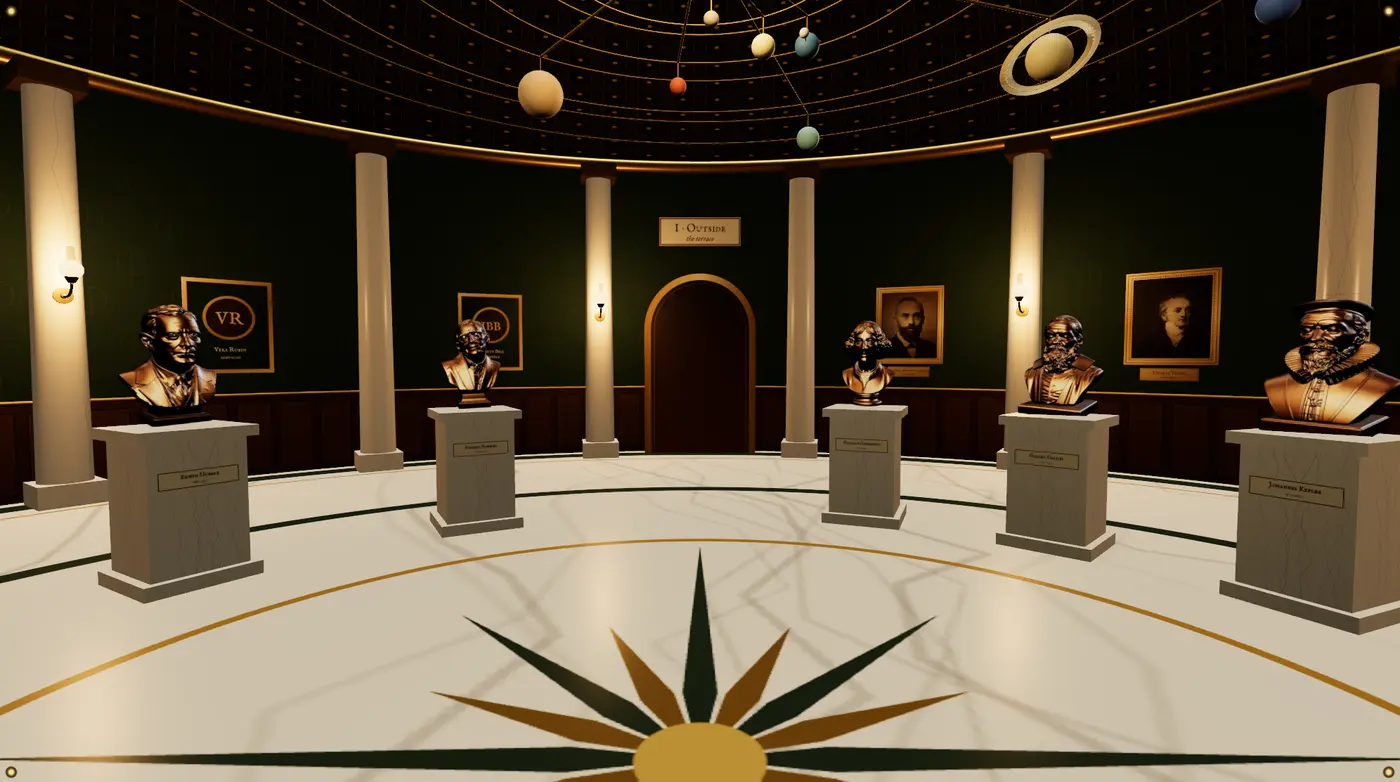
Walk round a bust and it turns with you. The busts come from 3D-printable models published on Printables, each one credited and left as it was published. Getting bronze to look like bronze and not like a chocolate Easter bunny took more tries than I will admit here. Click anyone, in the hall or in a room, and their card tells you who they were and where they belong in the building.
What is next
The hangar has room for more. The next one is about rockets: why it takes a rocket the height of a 40-storey building to put a few dozen satellites in orbit, and why bringing it back costs fuel you would rather spend on cargo. It will appear on the plan by itself; the building is drawn from the same list as the doors.
The plan is at the Observatory. The terrace is the easy way in.
— TimoNov 20, 2026