
 If You’re Replicated, Are You Still You?
Star Trek treats replicators and transporters as everyday technology. Food appears on demand. People dissolve into light and reappear across the galaxy. Most of the time, no one questions it.
But if you stop and think about what those machines actually do, a deeply unsettling question appears:
If you are perfectly copied, do you survive — or are you replaced?
And if more than one copy survives, what does “you” even mean anymore?
Cloning Is Real — and That’s Where the Trouble Starts
When Dolly the sheep was cloned in 1996, it proved something profound and disturbing: a complex living organism could be duplicated from existing biological material. Dolly had the same nuclear DNA as the donor sheep — but no one believed Dolly was that sheep.
That feels obvious, because continuity was never implied. Dolly didn’t inherit memories, personality, or subjective experience. She was genetically identical, but experientially new.
Star Trek transporters are different.
They don’t just copy DNA. They reconstruct the entire physical and neurological state of a person — memories, habits, personality, fears, intentions — everything that subjectively feels like you.
That difference turns cloning from a biological curiosity into a philosophical problem.
The Transporter Problem: Invisible Death or Perfect Continuity?
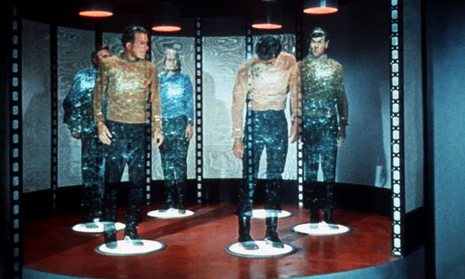
A Star Trek transporter:
- Scans your body in totality
- Converts matter into energy
- Disassembles the original
- Reconstructs the pattern elsewhere
From the outside, continuity looks perfect.
From the inside, it feels perfect.
But if identity depends on continuous physical existence, then transporters kill you — painlessly, undetectably — and replace you with someone who merely believes they are you.
There is no moment of death.
No gap in consciousness.
No warning.
Which makes the problem harder, not easier.
When Identity Splits: Riker, Boimler, and the End of Uniqueness
Star Trek occasionally breaks its own illusion.
In The Next Generation episode “Second Chances”, a transporter malfunction creates two William Rikers. Neither is a copy. Neither is secondary. Both share the same memories up to the split.
From that moment on, William Riker no longer exists as a single person.
Identity branches.
Lower Decks treats a similar duplication of Brad Boimler with uncomfortable casualness. One copy eventually dies — not because he’s less real, but because the universe can’t accommodate both.
These episodes quietly reveal something radical:
Personal identity is not inherently singular — physics usually just forces it to be.
Survival Without Exclusivity
If two copies of you wake up, both:
- Remember being you
- Feel continuous
- Expect your future
Neither is wrong.
What dies is not the self, but the assumption that the self must be unique.
From the inside, survival is complete.
From the outside, identity has fractured.
Why Not Just Fix People in the Pattern Buffer?
Once you accept how powerful transporter technology is, another question becomes unavoidable:
Why does disease still exist in Star Trek at all?
If a transporter can reconstruct you atom by atom, why not:
- Remove tumors
- Filter out pathogens
- Reverse injuries
- Restore a previous healthy version of you
Why have sickbay?
The answer is partly technical, partly ethical, and partly narrative.
The Pattern Buffer Is Not a Perfect Backup
Star Trek treats pattern buffers as temporary and unstable. Patterns degrade. Long-term storage is dangerous. Scotty surviving decades in a buffer (Relics) is treated as reckless luck, not a medical procedure.
Transporters are designed to move living processes — not archive them safely.
Living Beings Are Not Static Objects
Your body — especially your brain — is a constantly changing system. “Fixing” one thing risks altering another. Editing a neural pattern means editing who you are.
Which leads to the real problem.
Healing vs. Redesign
Memories and personality are physically encoded. If a transporter can repair neural damage, it can also:
- Remove memories
- Alter behavior
- Adjust temperament
- Rewrite personality
And canon strongly suggests this is possible. People are merged (Tuvix), de-aged, genetically altered, duplicated, or changed accidentally during transport.
If it can happen accidentally, it can happen deliberately.
Transporters are not just transportation devices — they are identity-editing machines.
The reason Star Trek doesn’t use them this way routinely isn’t because it can’t.
It’s because it shouldn’t.
Sickbay exists because medicine, in Star Trek, is about preserving continuity, not reverting or overwriting the self.
Tuvix and the Ethics of Continuity
Tuvix forces this issue into the open. He is not a glitch — he is a person with memories, agency, and fear of death. When Janeway orders his separation, Star Trek presents a moment where restoring the past requires killing the present.
There is no clean answer — and Star Trek knows it.
The Unspoken Rule: This Is Still a Story
There is, finally, a reason Star Trek never lets transporters solve everything.
If transporter pattern editing were treated as a routine tool:
- Death would be reversible
- Trauma could be undone
- Failure would lose meaning
- Conflict would evaporate
The show would stop being about people and start being about system administration.
Star Trek quietly limits transporter omnipotence because perfect solutions make for boring stories.
The inconsistencies aren’t mistakes — they’re pressure valves.
Technology in Star Trek is not a blueprint.
It’s a metaphor.
So… Are You Still You?
Replication doesn’t destroy the self.
It reveals that the self was never a singular object to begin with.
You are not the atoms.
You are not the body.
You are not even the uninterrupted process.
You are a continuity of experience — one that can, in theory, branch.
Star Trek doesn’t give us answers because answers would end the conversation.
And maybe that’s the point.
A future without scarcity still needs meaning.
A future without death still needs stories.
And a future with perfect replication still needs to ask what it means to remain human.